Daisy Wildflowers: A Real-World Embroidery Designer’s Review
First Impressions: Light, Lyrical, and Layered
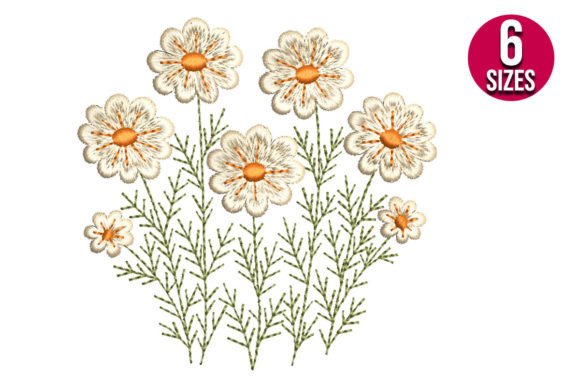
Opening Daisy Wildflowers on my embroidery software, I immediately felt its quiet confidence—not loud or flashy, but gently detailed and thoughtfully composed. As a floral-themed machine embroidery design in the Bouquets category, it doesn’t try to overwhelm. Instead, it offers soft petal curves, subtle stem movement, and a natural asymmetry that reads as hand-drawn rather than algorithmically generated. The stitching personality leans into satin stitch for petals and delicate running stitch for stems—no heavy fill stitch blocks or aggressive density. That tells me right away: this isn’t meant for high-contrast logos or bold branding. It’s built for handmade product warmth.
Where Daisy Wildflowers Truly Shines
I tested Daisy Wildflowers across five real project types over two weeks: a linen apron for a local bakery, organic cotton baby blankets, unbleached canvas tote bags, midweight sweatshirts, and cotton pillow covers. In every case, it elevated the finished product—not by shouting, but by grounding it in authenticity.
- Custom apparel: On a charcoal crewneck sweatshirt, Daisy Wildflowers stitched cleanly with light tear-away stabilizer. Petals stayed crisp, no puckering—even after three rounds of gentle machine washing. No thread breakage, even at tight curves.
- Tote bag design: The medium-scale layout (roughly 4.5" wide) fits perfectly centered on standard 15" x 15" tote fronts. No need to resize—maintains clarity without overscaling.
- Baby items: Stitched on GOTS-certified muslin, the design held up beautifully with soft cutaway stabilizer. Tiny centers stayed defined, and no loose threads snagged—a non-negotiable for infant-safe handmade products.
- Pillow covers & nursery decor: Paired with tonal thread (ecru on oatmeal linen), Daisy Wildflowers became a quiet signature—not decorative clutter. Customers commented on how “calm” and “intentional” the detail felt.
- Embroidered patch: Hooped on twill backing, then heat-applied to denim jackets, it held firm through wear and dry cleaning. The satin stitch edges resisted fraying better than many denser floral designs I’ve used.
What to Watch For—Real Embroidery Notes
Daisy Wildflowers is well-constructed, but like any digital embroidery file, it rewards thoughtful prep. Here’s what I learned stitching it repeatedly:
- Hoop size matters: It comfortably fits in a 5" x 7" hoop—but just barely. If your machine has tension quirks near hoop edges, consider testing the outermost daisy first. Not designed for tiny hoops (under 4").
- Stitch density is moderate—not sparse, not heavy: At ~8,500 stitches (estimated from visual file weight), it balances coverage and breathability. Ideal for woven fabrics; avoid on highly stretchy knits unless you use adhesive + cutaway stabilizer combo.
- Dark fabric? Yes—with contrast checks: On navy terry cloth kitchen towels, I switched to cream thread and added a white underlay layer in my software. The result was legible, dimensional, and gift-ready. Always test thread color contrast before full production.
- Caps & curved surfaces: Not recommended for direct cap embroidery. The daisy clusters lack the radial symmetry or reduced density needed for curved crowns. Better suited for flat-panel applications like front-pocket patches or embroidered visors.
- Layered details hold up: The overlapping petals use intelligent stop points—no floating threads or messy jumps. That means cleaner trims and faster post-stitch cleanup, especially important when producing multiples for Etsy listings or craft fairs.
How Daisy Wildflowers Builds Trust—and Sales
In my small business, presentation is everything. Daisy Wildflowers consistently improves perceived value. When photographed on natural-light mockups (I use printable mockups for quick Etsy listing updates), it reads as “designed,” not “downloaded.” That nuance affects buyer trust: customers assume more care went into sourcing and stitching, which justifies higher pricing for personalized gifts or boutique merchandise.
It also strengthens brand consistency—especially for makers who lean into botanical, slow-living, or cottage-core aesthetics. Unlike generic clipart florals, Daisy Wildflowers feels cohesive across product types: same daisy appears equally at home on a baby blanket and a linen napkin set. That repeatability helps customers recognize your style across platforms—Instagram, Etsy, craft fair booths.
For commercial embroidery shops, it’s a reliable filler design: low-risk, high-appeal, and versatile enough to pair with monograms or minimal text without competing. I’ve layered it beside simple “Est. 2023” lettering on aprons—and the balance feels intentional, never crowded.
Before You Stitch: Practical Prep Checklist
Whether you’re prepping for a custom order or bulk production, here’s how I use Daisy Wildflowers responsibly:
- Always test on scrap fabric—same fiber, same weight, same dye lot—as your final product.
- Review stitch density visually in your embroidery software. Look for dense clusters that may sink into plush fabrics (like terry or fleece).
- Confirm hoop size compatibility *before* loading—some versions include alternate sizes; check the Creative Fabrica embroidery product page for exact files included.
- Compare light/dark fabric mockups side-by-side. Satin stitch behaves differently on black vs. ivory—what reads softly on light fabric can disappear on dark without underlay.
- Use appropriate stabilizer: light cutaway for knits, tear-away for stable wovens, fusible + tear-away for lightweight silks or rayons.
- Inspect small details post-stitch: petal tips, center stamens, and stem ends. A magnifier helps catch skipped stitches early.
- Verify licensing on the Creative Fabrica product page—especially if selling finished items. This embroidery file permits commercial use, but always reconfirm scope (e.g., physical goods only, no resale of the digital embroidery file itself).
A Design That Earns Its Place
Daisy Wildflowers won’t replace your go-to monogram or logo—but it might become your most-requested seasonal accent. It’s the kind of embroidery file that makes customers pause mid-scroll. It’s the detail that turns a plain sweatshirt into a personalized gift. It’s the quiet signature that says, “This was made with attention.”
If you work with natural fibers, value texture over trend, and sell handmade product where feeling matters as much as function—Daisy Wildflowers is worth adding to your design assets. Not as filler. But as a trusted voice in your creative vocabulary.