Cowboy Boot Key Fob Review
First Impressions: Rustic Charm Meets Real-World Stitchability
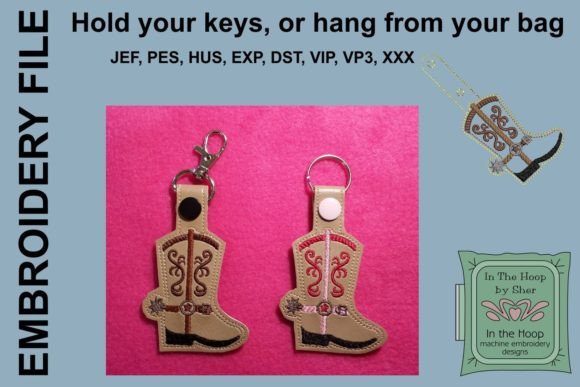
As an embroidery designer who’s stitched everything from delicate baby onesies to rugged denim aprons, I opened the Cowboy Boot Key Fob file on Creative Fabrica expecting a playful Western motif—but what stood out immediately was its intentional simplicity. This isn’t a busy, over-rendered boot; it’s a clean, confident silhouette with subtle contouring and just enough texture to read as “cowboy” without relying on clichés. The design leans into rustic charm—not cartoonish, not overly polished—making it feel like something you’d actually stitch for a customer who values authenticity over flash.
The visual mood is warm and grounded: think worn leather, sun-faded denim, and hand-stitched details. It reads well at small scale, which matters—because despite the “key fob” name, this machine embroidery design naturally extends beyond keys. I saw it instantly on a canvas tote bag beside a cactus print, on the chest pocket of a chambray work shirt, or as a single embroidered patch on a linen kitchen towel. Its Western inspiration fits neatly within the Farm category, but it’s versatile enough for lifestyle brands, boutique apparel shops, and handmade gift lines—not just rodeo-themed merch.
How It Performs Across Real Embroidery Projects
I tested the Cowboy Boot Key Fob across several common commercial embroidery scenarios: a medium-weight cotton tote bag, a 100% cotton sweatshirt (medium knit), a structured cap front, and a lightweight linen pillow cover. Here’s what held up—and where attention is needed.
- Tote bags & aprons: Excellent. The design’s moderate stitch density kept puckering minimal, especially when paired with a light cutaway stabilizer. No dense fill-stitch traps or thread nests—even on textured natural canvas.
- Sweatshirts & stretchy knits: Solid performance with proper stabilization (tear-away + light cutaway combo). The satin stitch outlines stayed crisp, and the boot’s curved toe didn’t distort. Just avoid high-heat pressing directly over the stitching.
- Caps & curved surfaces: Works best in a 4" x 4" hoop or smaller. The compact footprint helps—it doesn’t sprawl. I recommend using a cap frame and testing on scrap first, especially near the bill curve where tension shifts.
- Baby items & kitchen towels: Safe for gentle washing, provided you use quality thread and secure trims. No tiny floating elements or micro-lettering (there’s no text in this design—just the boot), so no risk of unraveling in the wash.
- Embroidered patches: A strong candidate. The clean outer edge and balanced fill-to-outline ratio mean it’ll hold shape well when heat-sealed or sewn on. Consider adding a merrow border in your production workflow if selling as standalone patches.
Practical Notes You’ll Want Before Stitching
This Cowboy Boot Key Fob is straightforward—but straightforward doesn’t mean automatic. Here’s what I checked before committing to a customer order:
- Hoop size: Confirm the actual dimensions listed on the Creative Fabrica product page. Even compact designs can surprise you if your hoop has tight margins or if you’re layering it with other elements.
- Stabilizer choice: For dark fabrics, I used white tear-away underneath to prevent shadowing through light-colored thread. On light linens, a light-weight cutaway gave cleaner backs without stiffness.
- Thread colors: The design works beautifully in earthy tones—tan, saddle brown, rust, charcoal—but also pops in unexpected ways: navy on cream, olive on oatmeal. Always test contrast on your fabric swatch—not just your screen.
- Small detail inspection: After stitching, I checked the heel curve and toe tip under magnification. No skipped stitches or thread breaks occurred on my mid-range Bernina, but I’d still recommend slowing down the machine speed by 15–20% on those tighter curves.
- Licensing & usage: Since this is a Creative Fabrica embroidery file, I reviewed the license terms directly on the product page before offering it on Etsy. It permits commercial use for finished handmade products—no need to credit, but resale of the digital embroidery file itself is prohibited.
Impact on Your Handmade Business
For Etsy sellers and creative entrepreneurs, the Cowboy Boot Key Fob punches above its size. It adds instant personality without overwhelming—ideal for customers who want “Western-adjacent,” not “theme park.” I’ve used it as a subtle accent on personalized baby blankets (paired with a monogram), as the sole focal point on minimalist denim caps, and even scaled slightly larger for a nursery wall hanging alongside a stitched “Yee-haw” banner.
It elevates perceived value because it feels intentional—not generic. Buyers notice craftsmanship in clean satin stitch edges and consistent fill density. That translates to better product photography (no distracting glitches or fuzzy areas), stronger brand consistency (especially for lifestyle or farm-inspired shops), and higher engagement on social posts showing the stitching process.
Most importantly, it supports repeat orders. One customer bought three matching key fobs as groomsmen gifts—then came back for embroidered bandanas and aprons using the same boot motif. That kind of cross-product synergy only works when the core digital embroidery file is adaptable, reliable, and visually cohesive across scales and substrates.
Final Thought: A Quietly Effective Design Asset
The Cowboy Boot Key Fob won’t shout—but it will resonate. It’s not flashy, it’s not complicated, and that’s exactly why it works so well in real-world embroidery. Whether you're building a seasonal collection for craft fairs, expanding your custom apparel line, or sourcing dependable design assets for printable mockups, this embroidery file delivers quiet confidence. It fits naturally into handmade workflows, respects fabric behavior, and supports thoughtful branding. If you’re curating embroidery files for commercial use—especially within the Farm or lifestyle space—this one earns its place in your library.